
Electroless Nickel Plating for Aerospace and Defense: Applications, Advantages, and Specifications
Aerospace and defense components frequently combine complex geometries with tight dimensional tolerances. Threaded bores, recesses, and internal passages can be difficult to coat evenly with electrolytic plating since the electric current concentrates at edges and corners leaving less coverage in recessed areas. Many of these parts also operate in environments that expose them to moisture, salt air, and de-icing fluids. Furthermore, weight-sensitive designs add to the complexity when relying on engineering polymers and composites. These polymers are by nature electrically insulating and cannot be electroplated without first being given a conductive surface.
Electroless nickel plating addresses several of these problems at once. Because it is deposited chemically rather than with applied current, plating thickness does not depend on current distribution. Electroless nickel plating can also be applied to suitably prepared non-conductive substrates to provide corrosion resistance and hardness.
How Electroless Nickel Deposition Works
Electroless nickel is deposited through autocatalytic chemical reduction. A reducing agent in the plating bath reduces nickel ions onto the part surface, and the newly deposited nickel catalyzes further deposition. Since no electrical current is involved, the deposit avoids the edge buildup and thin recesses that current-density variation produces in electrolytic plating. This gives electroless nickel a much more even coverage on the “nooks and crannies.”
Deposition still depends on fresh solution reaching the surface, so deep blind holes and narrow passages can plate thinner if circulation is restricted or air is trapped. Parts with this kind of complex geometry are worth reviewing beforehand, since fixturing and orientation in the bath can make a significant difference. The reducing agent also introduces phosphorus into the deposit. Phosphorus content has a major effect on the coating’s structure and properties, and it is discussed in detail in our companion article on high-phosphorus versus mid-phosphorus deposits.
Why Engineers Specify Electroless Nickel
Electroless nickel is usually considered as an alternative to electrolytic nickel or another conventional finish, and part geometry is often the deciding factor. When current-density variation would push a bore or thread out of tolerance, electrolytic plating may require auxiliary anodes or post-plate machining to bring the part back into specification. Electroless nickel can often coat the same part to final dimensions in a single operation.
Corrosion resistance is also a common reason for specifying electroless nickel plating. High-phosphorus deposits are generally amorphous in the as-plated condition, which means they lack the grain boundaries that can act as pathways for corrosion in crystalline coatings. This structure contributes to their performance in chloride and marine environments, although coating thickness and porosity have an equally large effect on how well a part holds up in service.
Electroless nickel also offers substantial as-plated hardness, which can be increased through post-plate heat treatment for wear-facing applications. The values that can be achieved depend on deposit chemistry and bake schedule, which is an important conversation to have with SAT Plating against your actual requirements.
Finally, electroless nickel can be applied to certain engineering polymers and composites after appropriate surface preparation and activation, provided the process is compatible with the substrate. This supports the lightweight component strategies that metal-substitution programs depend on. On polymers, electroless nickel is typically one layer within a multilayer coating system. On metals and polymers alike, it is also widely used as a barrier layer or underplate beneath other finishes, including some solderable finishes.
Where Electroless Nickel Shows Up in Aerospace and Defense
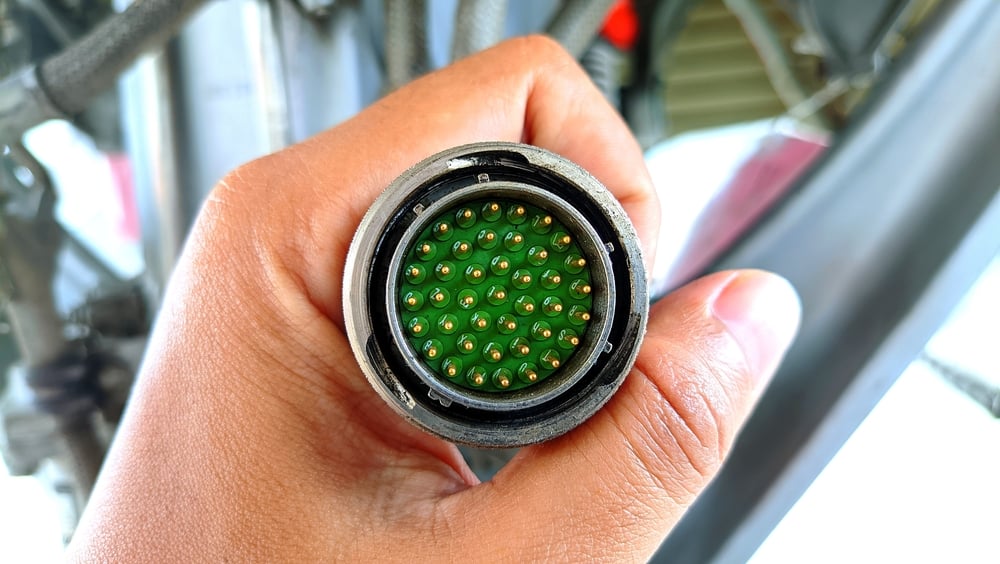
Connector hardware is one of the most common applications of electroless nickel plating in aerospace and defense. Connector shells, backshells, and associated hardware need corrosion protection and consistent thickness across complex machined geometries. Electroless nickel is widely used as the final protective finish on aluminum connector shells.
Contacts are a different case; on mating surfaces, electroless nickel typically serves as a barrier and underplate beneath the contact finish rather than as the contact interface itself. For a related look at connector finishes in harsh service, see our article on connector plating for offshore drilling platforms.
Plated polymer housings and enclosures are a second application. Metal substitution reduces weight but removes the conductivity and environmental protection the metal provided. Plated polymer housings may use copper as the primary conductive layer for EMI shielding, with nickel applied over it for environmental protection and durability.
Actuation and mechanical components form a third category. Electroless nickel may be specified on components such as valve bodies, pistons, shafts, and linkage hardware where corrosion protection, wear resistance, and dimensional consistency are required together. Suitability depends on contact conditions, loading, substrate properties, and whether post-plate heat treatment is appropriate for the part. Because deposit thickness adds directly to part dimensions, precision-machined components are often machined undersize to allow for the coating, and electroless nickel’s uniformity makes that allowance more predictable than it would be with an electrolytic deposit.
Specifications and Quality Requirements
Electroless nickel is plated to a written specification which is usually indicated on the part drawing. The specification sets requirements such as phosphorus content, thickness, heat treatment, and testing. SAE AMS 2404 is the most commonly referenced specification in aerospace work. Older drawings may still cite MIL-C-26074, which has since been sunsetted, so it is worth confirming the governing specification and revision before production.
Parts made from high-strength steel need particular attention, because the plating process can introduce hydrogen that makes the steel brittle. The governing specification may require a bake after plating to remove it. Defense programs also carry documentation, traceability, and ITAR requirements, which makes a plater’s quality system as important as its plating capability.
Conclusion
Electroless nickel is widely specified in aerospace and defense because it combines thickness uniformity on complex geometries, corrosion resistance, and the ability to metallize suitable non-conductive substrates. The specification decisions that follow, including phosphorus content, thickness, and heat treatment condition, determine whether the coating performs as intended in a given application.
SAT Plating provides electroless nickel plating for aerospace and defense programs, including plating on engineering polymers. SAT Plating is ITAR registered and compliant and maintains an ISO 9001:2015-certified quality management system, supporting programs from prototype development through full-scale production. To discuss substrate compatibility, specification requirements, or your application, contact SAT Plating to speak with a plating specialist.