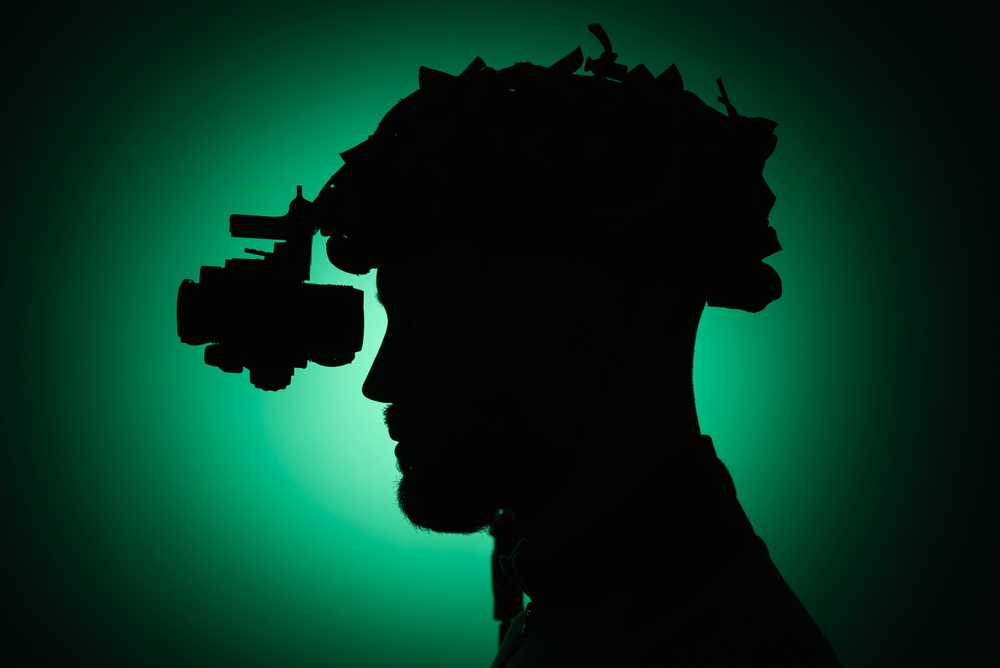

EMI Shielding in Modern Night Vision Systems: Protecting Sensitive Electronics in Lightweight Housings
Military electronics are fielded under electromagnetic compatibility requirements, a fact from which night vision systems are not exempt. Meeting those requirements has grown harder as systems integrate digital displays, processors, sensors, and data connectivity, and as the concentration of EMI sources and EMI-sensitive equipment around them grows. The materials make it harder still: housings are chosen for weight, and the lightweight polymers that meet that constraint provide essentially zero shielding or conductivity of their own. How a lightweight housing becomes part of the electromagnetic answer ultimately comes down to shielding design, and shielding design comes down in large part to surface treatment and plating.
Inside a Modern Night Vision System
The image intensifier tube is the heart of the modern night vision system. A photocathode converts incoming photons to electrons, a microchannel plate multiplies those electrons by orders of magnitude, and a phosphor screen converts the amplified electron stream back into visible light, turning starlight into usable vision.
The electronics around the tube are where electromagnetic compatibility enters. A high-voltage power supply drives the tube, gain control circuitry manages performance across changing light conditions, and some current-generation and integrated systems add digital processing, displays, sensors, and data connectivity. Each of these subsystems can be a source of electromagnetic emissions, a victim of them, or both.
The intensification process itself is sensitive to stray light, not radio energy, which is why night-vision-compatible lighting is governed by its own military specification. The electromagnetic compatibility concern belongs to the electronics, and it is documented at the requirements level. Military procurement invokes EMC standards that require equipment to demonstrate controlled emissions and controlled susceptibility before it is fielded.
The Electromagnetic Compatibility Challenge
Interference sources divide into two categories. Platform-generated interference comes from equipment operating alongside the vision system: avionics, radios, power systems, and the growing inventory of soldier-carried digital devices. External interference comes from the RF emitters that surround any modern operation, including radar and communications equipment, with electronic warfare environments representing the extreme end of the exposure range.
The compatibility problem runs in both directions. The vision system’s own electronics must not interfere with each other or with adjacent equipment, and external RF energy must not disrupt the system’s electronics. A night vision device that degrades a soldier’s radio, or a radio that compromises the soldier’s night vision, is a mission problem either way.
The problem is getting harder, not easier, as night vision devices operate closer to more emitters than ever before, often within centimeters of transmitting antennas on the same helmet or vehicle. And the constraint that makes this difficult is weight. Every gram added to head-worn equipment contributes to the operator’s load, driving designers toward engineering polymers, composites, lightweight metals, and hybrid construction. When a nonconductive polymer is selected for the housing, the enclosure no longer provides the inherent electrical conductivity of a metallic housing, and the shielding function has to come from somewhere else.
Shielding Strategies for Lightweight Housings
The physics of shielding starts with the Faraday cage principle: a continuous conductive enclosure around sensitive components attenuates electromagnetic energy passing in either direction. Metal enclosures provide this inherently. Conventional unfilled engineering polymers provide little inherent EMI shielding, so when the housing must function as part of the shielding enclosure, an added conductive layer is required.
Conductive plating on polymer housings resolves the conflict. Plating the polymer housing allows a lightweight polymer structure to become part of the system’s EMI-control strategy. The polymer carries the structural load, and the conductive coating provides the electrical surface needed for shielding and grounding functions, preserving the weight advantage that drove the material choice in the first place.
One common metallization approach uses a highly conductive copper layer to provide the primary shielding path, followed by nickel for durability, abrasion resistance, and environmental protection on a coating that will be handled, knocked, and exposed to weather throughout its service life. The specific materials, thicknesses, and layer sequence depend on the frequencies of concern, the substrate, and the application’s environmental exposure.
The details are where shielding integrity is won or lost. A conductive coating is only as effective as its continuity. Real housings are full of discontinuities such as housing seams, control apertures, and connector pass-throughs. Bonding between mating sections and gasketed interfaces carry the shielding function across these breaks. A perfectly plated housing can still be a poor EMI enclosure if continuity fails at the joints, which is why effective shielding design treats these features deliberately.
Plating Specifications and Performance Requirements
With regards to coating, the conductivity, thickness, adhesion, and continuity all influence shielding performance. With regards to assembly, the geometry, seams, apertures, bonding, and the frequencies of concern become more important as well. Specification work translates both levels into enforceable requirements: which surfaces receive coating, to what thickness, with what adhesion, and verified by what testing.
Two qualification domains govern this area. First, environmental qualification verifies physical durability under service conditions. For soldier-worn devices this means drops, impacts, temperature extremes, moisture and anything else a soldier may encounter in the field. Second, EMC qualification verifies electromagnetic behavior. This operates at the equipment level. For military programs where MIL-STD-461 is invoked, the standard provides requirements and test methods for controlling the electromagnetic emissions and susceptibility of equipment and subsystems.
Conclusion
Night vision systems are fielded under electromagnetic compatibility requirements, and in weight-constrained housings, meeting those requirements depends heavily on the shielding approach. The lightweight housing that makes a device wearable and the conductive coating that makes it part of the shielding enclosure are two halves of one design decision. As more electronics and wireless capability move into soldier-worn systems, electromagnetic compatibility will remain a defining design constraint for lightweight electro-optical equipment.
SAT Plating is playing a role in EMI shielding with polymer and composite housings for defense programs. From prototype development through full-scale production, SAT Plating supports programs of varying size and complexity. For more information on shielding coatings for night vision and electro-optical systems, contact SAT Plating to speak with a plating specialist today.