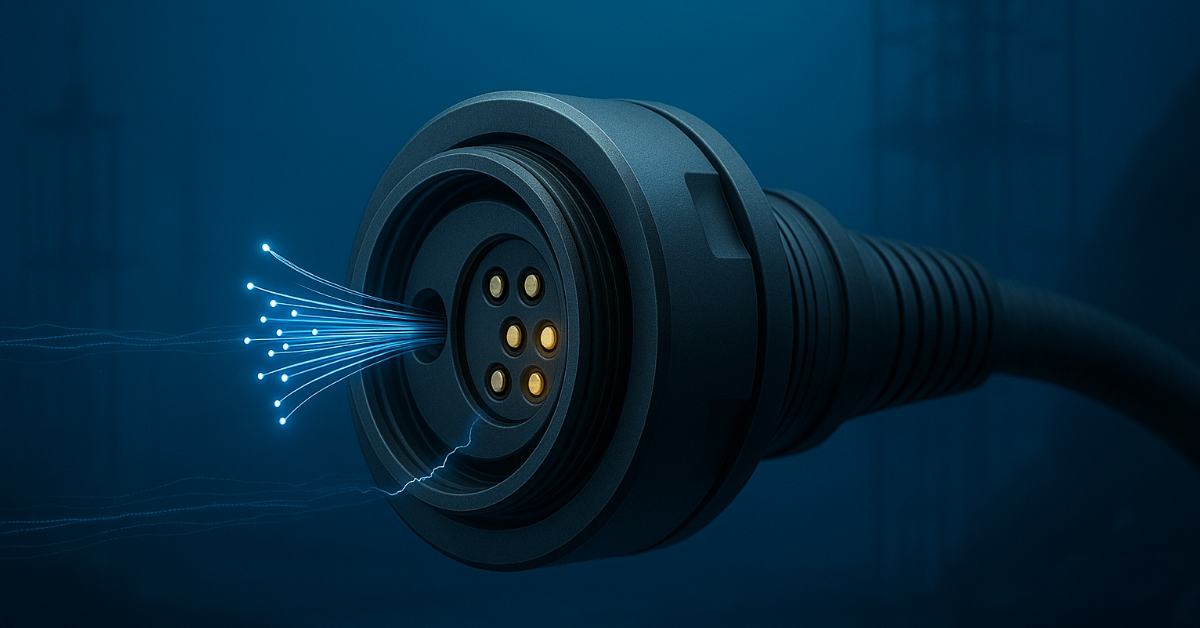

Subsea Fiber Optic and Power Hybrid Cables: Multi-Function Connector Design
As offshore industries push into deeper waters, the demand for subsea cables that can transmit both high-speed data and electrical power has grown sharply. These hybrid systems are the backbone of undersea research stations, offshore energy installations, and long-haul communications networks. At the heart of this technology is the multi-function connector. These are the highly engineered links that keep optical and electrical systems operating flawlessly under some of the harshest conditions on Earth.
Why Combining Fiber Optics and Electrical Power Is So Challenging
Hybrid subsea connectors are far more than a simple coupling device. They must align optical fibers with micron-level precision while also delivering a steady electrical current. The underwater environment adds further hurdles: extreme pressure, saltwater corrosion, biofouling, and temperature swings all threaten performance. Unlike purely optical or purely electrical connectors, these devices have to manage both functions simultaneously without interference, degradation, or loss.
Multi-Function Connector Design Requirements
An effective subsea connector must keep the fiber optic cores perfectly aligned to prevent even the smallest signal loss. This alignment has to remain stable despite pressure and mechanical stress. At the same time, the electrical portion of the connector must provide consistent, low-resistance contact surfaces capable of carrying current without heating or degrading. Both systems must be completely sealed from seawater intrusion, which requires highly engineered sealing solutions that work for both optical and electrical pathways. On top of that, these connectors need to be serviceable in wet conditions, often by remotely operated vehicles (ROVs), which means the mating and unmating processes must be straightforward, secure, and repeatable.
Meeting these combined requirements calls for precise mechanical design, exacting manufacturing standards, and advanced material treatments. This is particularly true for plating technologies that protect components from wear, corrosion, and environmental damage over years of continuous use.
Dual-Function Design Challenges
Carrying both data and electrical current in the same connector presents a unique challenge. Optical signals are extremely sensitive to interference and require an environment free from electrical noise. Careful design is required to ensure that both systems operate independently yet harmoniously within the same housing.
Achieving the necessary fiber alignment is a challenge in itself. A deviation of just a few microns can cause significant optical losses, especially over long transmission distances. The connector must maintain this alignment through bending stresses and the mechanical force applied during mating and unmating.
Electrical contact reliability is equally important. Under the crushing pressure of deep water, even the smallest deformation in a contact surface can increase resistance, generate heat, and reduce efficiency. These contacts also face the constant threat of corrosion, so the plating on the contact surfaces must be chemically resistant while still providing excellent conductivity.
The sealing system presents another layer of complexity. Unlike a single-purpose connector, which might have one type of seal, a hybrid connector has to ensure that both optical and electrical paths remain isolated from seawater. This becomes especially demanding when connectors are handled underwater, where exposure to pressure changes, silt, and marine organisms can challenge even the best sealing designs.
Operating in High-Pressure Environments
At depths beyond 6,000 meters, hydrostatic pressure exceeds 8,700 psi, creating forces that can distort materials and compromise performance. Metal housings may compress slightly, altering internal tolerances, while certain plastics can deform permanently over time. To counteract this, engineers use two general approaches: pressure-compensated systems, which equalize internal and external pressure by allowing non-conductive fluids inside the housing, or pressure-resistant designs that rely purely on mechanical strength to keep water out. Both methods require materials and platings that can withstand decades of pressure cycling without fatigue or failure.
Specialized Plating for Marine Conditions
SAT Plating’s expertise plays a critical role here. Plating is often the first and last line of defense against corrosion, wear, and performance loss.
Corrosion-Resistant Plating Systems
Corrosion-resistant platings, such as those made from gold, platinum, or palladium, prevent oxidation and maintain surface conductivity. Often, a multi-layer plating strategy is employed, with a base barrier layer (such as nickel) providing structural adhesion and an outer noble metal layer providing corrosion resistance. Electroless nickel plating, in particular, offers uniform coating even on complex geometries, which is essential for different connector shapes.
In certain cases, specialized alloy platings are used to combat specific environmental threats, such as high sulfur content in certain waters. These platings are engineered to perform over long periods without significant degradation.
Performance Plastic Plating
Many hybrid connectors incorporate high-performance plastics to reduce weight or provide electrical insulation between conductive elements. Plating plastics for subsea use requires Surface Activation® to create a bond between the polymer substrate and the metallic layer. Selective plating techniques allow metal coatings to be applied only to specific areas while leaving the rest of the component insulated. Rigorous quality control ensures that these plated surfaces resist delamination and maintain their electrical performance despite constant stress.
Environmental Durability Factors
Saltwater is one of the most aggressive natural environments for metals, attacking unprotected surfaces quickly and relentlessly. A connector without proper plating or coating can suffer from pitting corrosion within weeks, leading to early failure. Plating systems must therefore be engineered to resist this attack while still providing the required electrical and optical performance.
Biofouling adds another hazard, as marine life such as barnacles, algae, and tube worms can attach to connector surfaces. These organisms can physically block connector mating, obstruct optical paths, or interfere with seals. Certain plating finishes can help discourage attachment or make cleaning easier.
Temperature cycling is a concern across the operational range of subsea connectors. The amount of temperature cycling is limited in deep water, where temperatures hover just above freezing. However, cables that connect offshore wind farms or telecommunications networks where substantial sections of cable sit in 300 feet or less of water are much more vulnerable to thermal cycling. These temperature changes cause materials to expand and contract at different rates, which can put stress on plating layers at different depths.
Looking Ahead
Future hybrid connector designs will likely face even greater operational demands, from deeper installations to higher data rates and increased electrical loads. The role of specialized plating will remain central, as it provides both the chemical defense and the mechanical stability these systems need to operate reliably. With careful material selection, advanced plating processes, and comprehensive quality assurance, these connectors can continue to perform in the most challenging marine environments.
For more information on working with SAT Plating for your subsea connector project, get in touch with our customer success team. Whether you’re starting with research and development or need to produce millions of pieces annually, SAT Plating can accommodate any size project.